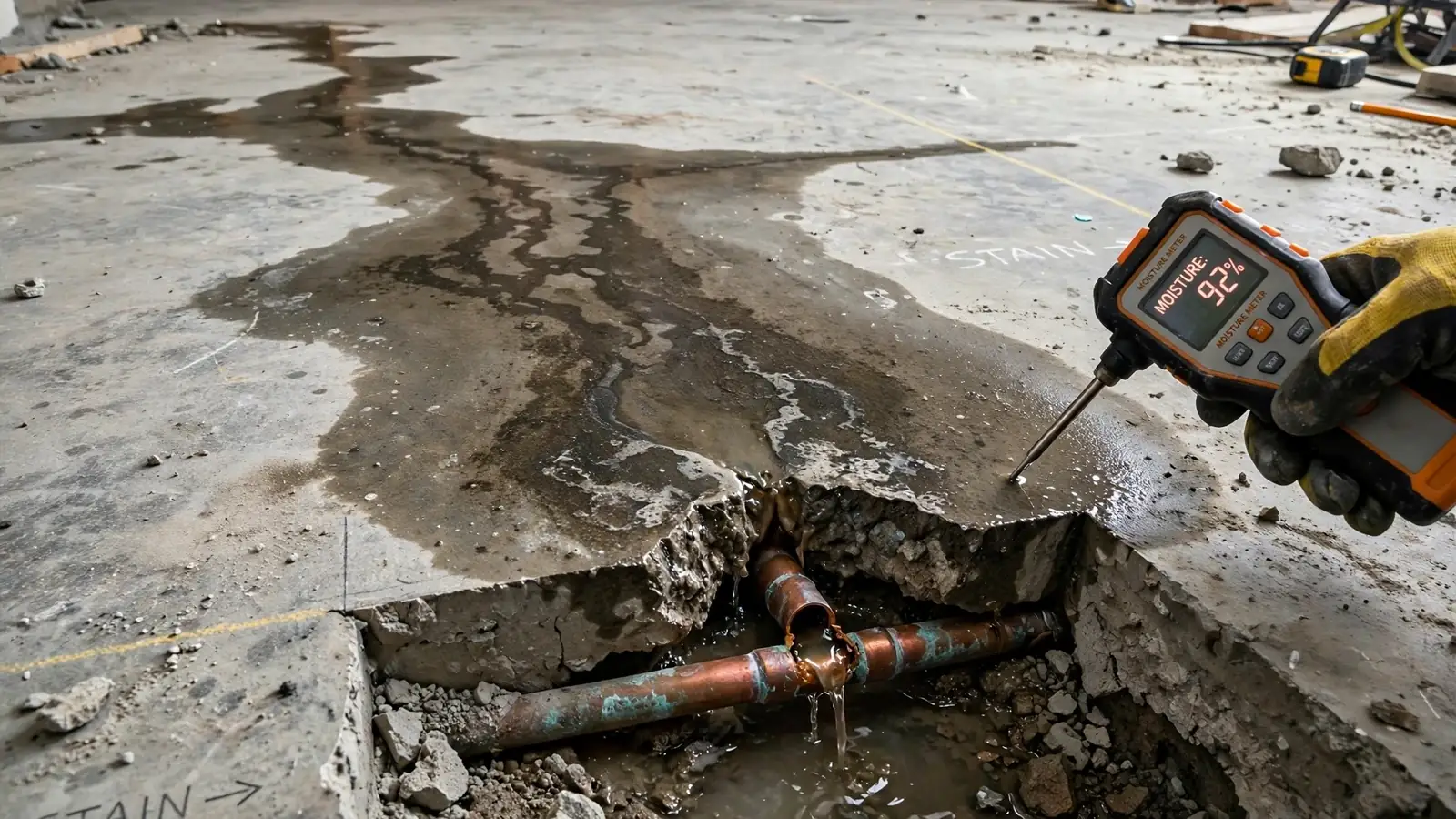
Water coming up under the floor: the warning signs
This Old House lists the common signs. Look for cracks in walls or baseboards, warm spots on the floor, low water pressure, the sound of running water with every fixture off, standing water near the foundation, a musty smell and carpet that keeps getting damp. A bill that jumps for no reason also fits.
One sign alone proves little. Several together, especially a moving meter and a warm spot, make a slab leak far more likely. The table below pairs each sign with other things that can cause it.
| Sign | Other possible cause | How to tell the difference |
|---|---|---|
| Warm spot on the floor | Sun through a window, a hot-water line near the surface, radiant heat | Check it at night with the water heater on, then repeat after turning the heater off |
| Wet carpet or damp tile | Roof leak, sweating air conditioning duct, plant pot or pet bowl | Dry it, then see if it returns with the home's water shut off at the main |
| Sound of running water | Running toilet, ice maker, irrigation timer | Check each fixture, shut off the ice maker and sprinklers, then listen again |
| Low pressure | Clogged aerator, partly closed valve, municipal work | Test several taps and ask neighbors if their pressure dropped |
| High water bill | More people at home, lawn watering, running toilet | Run the meter test below before assuming a slab leak |
What causes a slab leak, and what we cannot know
Plumbers commonly point to a short list of causes. Old copper or steel pipe can corrode through. High water pressure strains joints. A line can rub against concrete or gravel as the building settles. A bad fitting from the original install can fail years later. Each has been blamed in reported cases.
The honest answer is that the cause stays uncertain until the pipe is exposed and examined. We cannot tell you by phone whether yours was corrosion, pressure or a pipe that shifted. Anyone who names a cause before finding the leak is guessing.
What Dania Beach Homeowners Should Know About Ground Water
The USGS says the Biscayne aquifer sits at or near the land surface across most of its area, and water-table levels fluctuate roughly 2 to 8 feet a year with rainfall and pumping. Dania Beach sits on this aquifer, and the city draws its water from it. That means a damp slab edge after a heavy storm is not automatically a plumbing leak.
The meter test settles it. If the meter does not move with water off, and the dampness follows rain, it is probably ground water, not a pipe. If the meter moves, the leak is real. April 12 to 13, 2023 flooding showed how fast water can show up around a South Florida property.
Census ACS data gives Dania Beach a median build year of 1977, so many slabs and the pipes in them are decades old. Owners in nearby Pembroke Park or West Park can run the same meter test.
- USGS Hydrologic Atlas 730 (Biscayne aquifer) + US Census ACS + NAHB analysis of Census Survey of Construction + EPA WaterSense
How common are slab homes here?
Slabs are common in Florida, but numbers matter. An NAHB analysis of Census data found 85.7 percent of new single-family homes in the South Atlantic division were built on slabs in 2024. That covers new construction in a multi-state region, not Dania Beach and not older houses.
We could not find a published slab share for Dania Beach, and the Census does not publish one. Look at your own house. A home with no crawlspace, no basement and a floor that sits close to the ground is probably a slab.
Run the meter test before you pay for anything
The EPA's meter check is simple and costs nothing. Use no water for at least two hours, then read the meter again. Any change means a probable leak somewhere on the property, though not necessarily under the slab.
The test separates a plumbing leak from normal use. It works the same in a house or a mobile home that has its own meter.
- Turn off every faucet, ice maker, dishwasher and irrigation zone
- Read the meter and write down every number, including the small dial
- Wait two hours without using any water, then read it again
- Close the home's main shutoff and watch the meter once more
- If it moves with the main closed, the leak is before the shutoff, in the service line
- If it stops with the main closed, the leak is inside the house
Finding it without tearing up the floor
A plumber finds a slab leak with electronic listening, which hears the hiss through concrete, and thermal imaging, which can show a warm hot-water line. Pressure testing isolates which pipe is losing water. Angi lists slab leak detection at $150 to $400, and other guides run to $600.
Once the leak is located, there are three paths. Spot repair breaks the slab at the leak. A reroute abandons the buried line and runs new pipe through walls or the attic. A full repipe replaces everything. Our slab leak repair crew and leak detection technicians handle all the finding steps. Call Call (954) 697-4920 if the meter test fails.
Cost ranges and what insurance may do
Guides agree fairly well on repair. Angi and This Old House both list $630 to $4,400 with an average near $2,300, and Fixr shows $1,000 to $4,000. Breaking and patching the slab can add $300 to $6,750, and reroutes range from $600 to $15,000 because sources disagree. Florida prices vary.
Insurance is a minefield. NAIC notes that homeowners policies generally cover sudden and accidental discharge, and neglect can jeopardize a claim. Citizens Property Insurance forms carry a $10,000 limit on that peril and on constant or repeated seepage. Read your own policy and call your insurer before repairs, and keep photos of everything.
Frequently Asked Questions
Can a slab leak happen in a Dania Beach house on a high water table?
Yes, a pressurized line can leak no matter how high the ground water sits. High ground water can also hide a leak because the soil is already wet. The meter test is how you tell the two apart.
How do I know if my floor is damp from rain or a pipe?
Run the two-hour meter test with everything off. A moving meter points to a leak. A still meter and dampness that follows storms points to ground water or a roof or window problem.
Does a warm floor spot always mean a slab leak?
No. Sun through a window, a nearby hot-water line or an AC duct can all warm a floor. Pair it with a moving meter or running-water sounds before you worry.
Will insurance pay for slab leak repair?
It depends on your policy. Many cover sudden and accidental discharge and exclude slow seepage, and Citizens forms carry a $10,000 limit. Ask your insurer before work starts, and call Call (954) 697-4920 if you need the leak located first.
Do I need to call Sunshine 811 before a slab leak repair?
Indoor slab work generally does not involve digging in the yard. A service line repair outside does. Sunshine 811 asks for notice at least two full business days before digging.
Code reference: plumbing work in Florida falls under the Florida Building Code, Plumbing (8th Edition, 2023), which is based on the 2021 International Plumbing Code (IPC). Ask the Dania Beach Building Division whether your job needs a permit.